In April 2019 the world watched the roof and spire of Notre-Dame de Paris burn. A long debate followed: should the spire be rebuilt as it was, or should today’s architects design a new one with a contemporary signature? France chose to rebuild it as it stood before the fire, and the cathedral reopened at the end of 2024. That debate exposed something most visitors to Europe never think about: every old painting and wall we admire has passed through the hands of people who had to answer the question of how far to go.
Europe’s answers are not always unanimous, but they rest on clear principles. Knowing them changes how you see museums and churches, and offers something worth considering when we think about protecting heritage elsewhere.
Conservation, restoration, reconstruction: three different jobs
European professionals distinguish carefully between levels of intervention, each with its own standards.
| Level | What it involves | Examples |
|---|---|---|
| Preventive conservation | No contact with the object; only its environment is controlled | Stable humidity and temperature, limited light, pest control |
| Remedial conservation | Stopping damage from progressing without changing the image | Consolidating flaking paint, removing salts from stone |
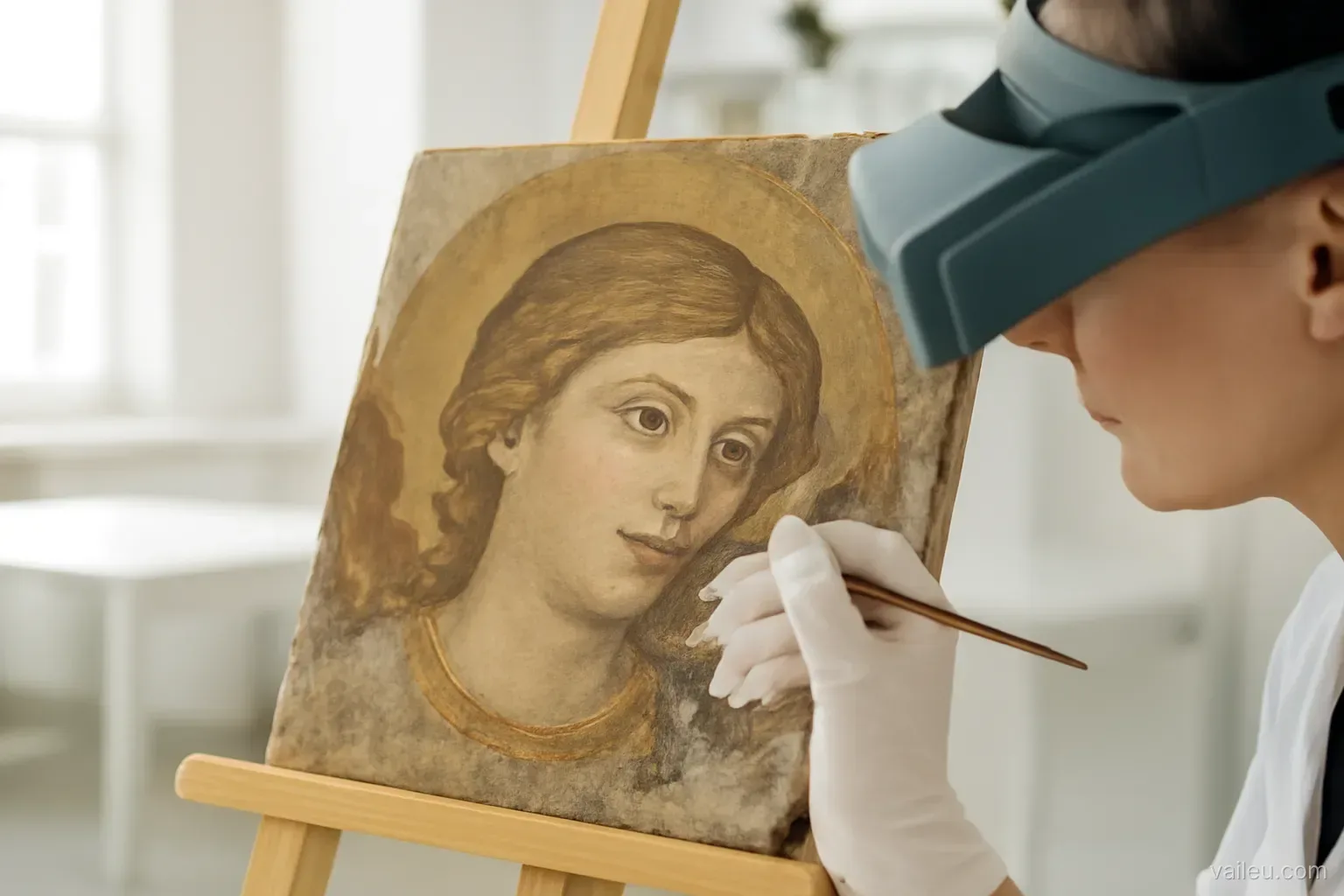
| Restoration | Making the work legible again, filling losses only as far as needed | Removing yellowed varnish, retouching losses |
| Reconstruction | Rebuilding what has been entirely or largely lost | Notre-Dame’s spire, districts destroyed in war |
The general rule is to work from the top of this list down: if preventive conservation is enough, do not restore; if restoration is enough, do not reconstruct. Each deeper level needs a stronger reason.
The Venice Charter and three core principles
In 1964 architects and conservators meeting in Venice adopted a document on the conservation of monuments, later known as the Venice Charter. It remains a reference point for the profession. Three of its principles can be seen with your own eyes:
- Stop where conjecture begins. The charter says restoration must stop at the point where hypothesis starts. If no record shows what a lost area looked like, nobody invents it.
- Additions must be distinguishable. New work should harmonise with the whole, yet a trained eye looking closely must be able to tell it from the original.
- Respect every historical layer. A Romanesque church that later gained Gothic windows and a Baroque altar does not need to be stripped back to one pure style. Each layer is part of the story.
The profession later added reversibility: materials used in repair should be removable without harming the original, so future generations with better methods can redo the work. That is why painting conservators prefer retouching paints and adhesives that dissolve in mild solvents, quite unlike the original paint.
Seeing the principles on paintings: tratteggio and neutral fills
In Italy in the mid twentieth century, conservators developed tratteggio: losses are filled with very fine vertical strokes placed side by side, each in a pure colour. From a few steps away the eye blends the strokes into a continuous area and the painting reads as a whole. Step closer and the lines are plainly visible, an honest signal that this part was added later.
When a loss is too large and there is no record of what was there, conservators often paint nothing at all and apply a neutral tone that sits slightly behind the painting’s colours. Viewers see the gap without being distracted by it. In Italian, German and Dutch museums, stand close enough to an old fresco or altarpiece and you will find both approaches.
Cleaning is a decision too. Removing centuries of grime and varnish from the Sistine Chapel ceiling in the 1980s and 1990s revealed unexpectedly bright colours and provoked fierce debate, with some arguing that part of the darker layer had been the artist’s intention. That debate is one reason every cleaning step today is tested on a small area, photographed and recorded before work continues.
Seeing the principles on buildings: Dresden and Warsaw
Dresden’s Frauenkirche was destroyed in the Second World War and its ruins lay in the city centre for decades. When it was rebuilt from the mid 1990s, the original stones that could still be used were numbered and set back in their original positions. Today its walls show dark, fire-marked blocks from the old church among pale new sandstone. Nobody tried to make them match: the contrast tells the story of destruction and recovery.
Warsaw’s historic centre was almost entirely destroyed in 1944 and rebuilt after the war using paintings, photographs and surveys that had survived. Near-total reconstruction is normally hard to accept as genuine heritage, yet UNESCO listed the district, reasoning that the carefully documented rebuilding, carried by the will of a whole nation, had historical value of its own. It was a considered exception, not a licence to rebuild everything that has been lost.
When restoration goes wrong
In 2012 a small wall painting of Christ in a church in Aragon, Spain, was repainted by a well-meaning local volunteer with no training. The image was transformed beyond recognition, and the story went around the world. Online it was a joke; for professionals it was the clearest illustration of why restoration is a craft that takes years to learn: understanding original materials, how paint ages, and when not to touch.
Professional mistakes are less amusing but more common: over-cleaning that strips the artist’s final thin glazes; patching old stone walls with cement that traps moisture so the surrounding stone decays faster; replacing roof tiles or timber wholesale because it is quicker and cheaper than repairing them one by one. Many of today’s professional rules grew out of exactly these errors.
Behind the gallery: science in restoration
Before any brush touches a work, European conservators usually assemble a scientific file:
- Infrared imaging reveals underdrawing beneath the paint and places where the artist changed the composition.
- X-radiography shows the structure of the support, nails, cracks, and sometimes an entirely different painting underneath.
- Analysis of tiny paint samples identifies pigments and shows which layers are original and which were added later.
- Environmental monitoring: paintings, wood, paper and textiles are sensitive to humidity and light. That is why rooms with works on paper are dimmer, and why some objects are shown only for limited periods before resting in storage.
Some museums turn the process into something visitors can watch. At the Rijksmuseum in Amsterdam, the research and restoration of Rembrandt’s Night Watch has been carried out inside a glass enclosure in the gallery, so visitors walking past can watch the specialists at work.
Visiting with a conservator’s eye
Next time you walk into a European museum or church, a few things are worth looking for:
- Stand close to an old fresco and look for areas of fine lines or neutral tone.
- Look at stone walls: new stone is usually paler, the mortar a different colour, sometimes with a small repair date carved in a corner.
- Read the label beside the work: many museums note the most recent restoration and who funded it.
- Notice scaffolding wrapped in printed sheeting showing the building: a sign that a restoration campaign is under way, often lasting years.
The lesson worth taking home is less a technique than an attitude: document thoroughly before touching anything, repair just enough rather than renew, and accept that the marks of time are part of the heritage. A historic building with every tile replaced and every column freshly painted may look smarter, but it has lost the very thing that made it worth keeping.
Frequently asked questions
What is the difference between restoration and reconstruction?
Restoration repairs and clarifies what still exists, based on evidence. Reconstruction rebuilds what has been lost entirely or largely. Reconstruction is accepted only in exceptional circumstances and with thorough documentation.
Why not repaint a damaged painting so it looks new?
Repainting lost areas from guesswork adds things the artist may never have painted. The European approach fills just enough for the whole to read, while keeping the original distinguishable up close.
What is tratteggio?
A technique for filling losses in paintings with fine, closely spaced vertical strokes. From a distance they merge into a continuous tone; up close they clearly mark the area as a later addition.
Where can visitors watch conservators at work?
Some major European museums have glass-walled conservation studios or carry out restorations inside the galleries. Check the museum’s website for current projects before you go.
Is an old town rebuilt after the war still genuine heritage?
In some cases UNESCO has said yes, as with the historic centre of Warsaw, because the rebuilding was carefully documented and expressed a nation’s will. It is a considered exception, not the default.