A walk through a European city is a walk through centuries of architecture within a few streets. You do not need to be an architect to enjoy it. Recognise a few clues — round or pointed arches, classical columns, curving façades, blocks of glass and steel — and you can guess a building’s era and understand why it was built that way. Architecture is an open-air history book, and Europe is a vast library.
Ancient Rome: the foundation of everything
The Romans left amphitheatres, temples, aqueducts and public baths across Europe. Two key inventions were the round arch and concrete, which allowed huge interior spaces. The Pantheon in Rome, with its dome open to the sky at the top, still stands after nearly two thousand years. Classical columns in three main orders — plain Doric, scrolled Ionic and leafy Corinthian — would be reused by every later age.
Romanesque: fortresses of faith
Around the tenth and eleventh centuries, many monasteries and churches were built in the Romanesque style. Easy clues: round arches, very thick stone walls, heavy columns, small windows and dim, solemn interiors. The buildings look as solid as castles, reflecting an unstable era when a church was both a place of prayer and a refuge.
Romanesque architecture survives in many villages and small towns in France, Spain, Italy and Germany, often quiet and free of crowds.
Gothic: reaching for light
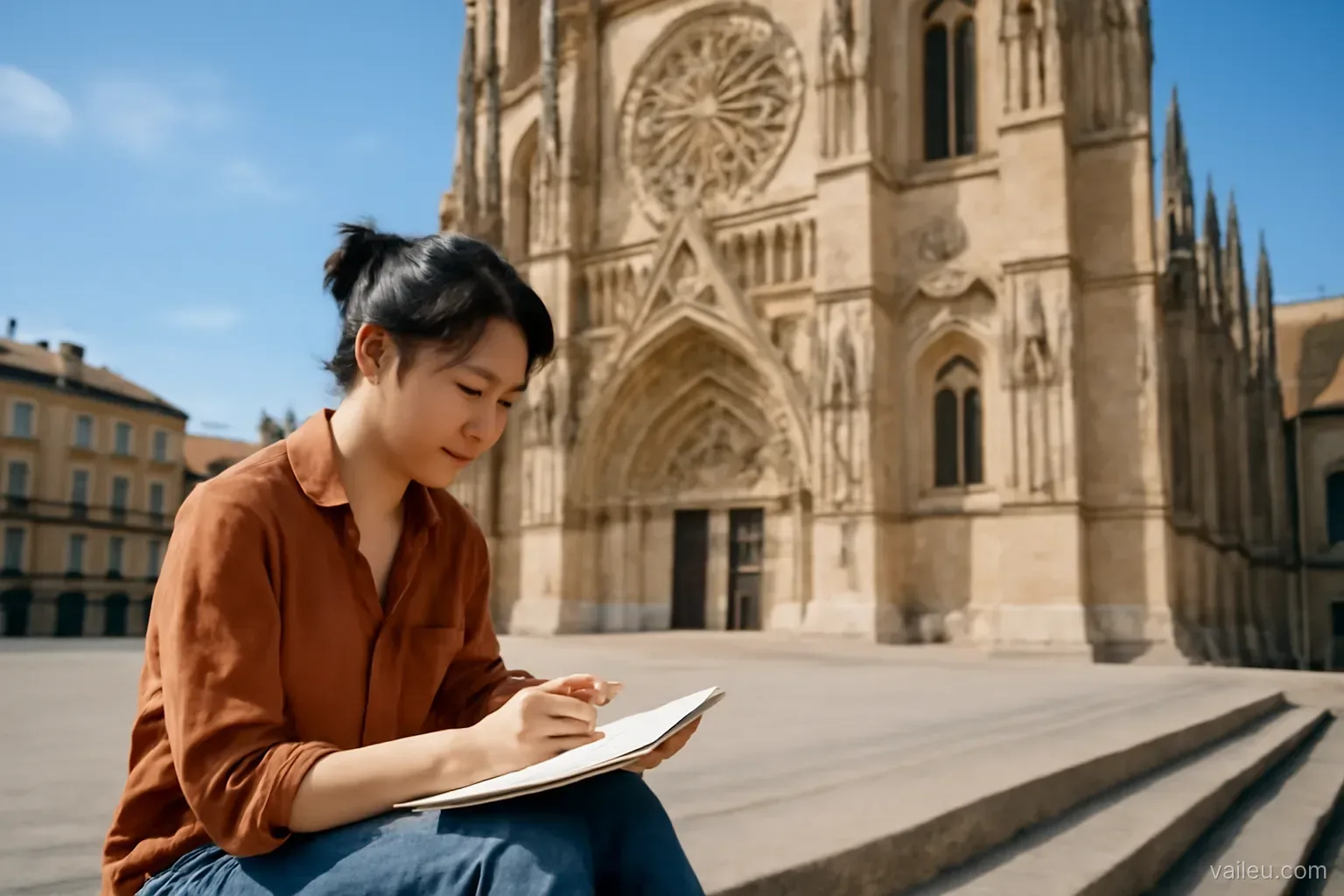
From the twelfth century, starting around Paris, Gothic architecture arrived like a revolution. Three technical inventions made it possible: the pointed arch, which spreads weight better; ribbed vaults criss-crossing the ceiling; and flying buttresses supporting walls from outside. Walls no longer needed to be thick, enormous stained-glass windows could open up, and buildings soared upward.
Step into a Gothic cathedral such as Chartres, Notre-Dame de Paris, Cologne or Milan and coloured light floods a towering space. Builders wanted to create a sense of heaven on earth. Stained-glass windows also served as a picture Bible for people who could not read.
Renaissance: the human measure
In fifteenth-century Florence, architects returned to study ancient Rome. Renaissance architecture sought balance, harmony and clear mathematical proportion. Clues: symmetrical façades, classical columns, the return of the round arch, great domes and evenly spaced windows. The dome of Florence Cathedral is a celebrated engineering achievement of this age.
The spirit behind it was humanism: people and reason at the centre, the world measured by the proportions of the human body.
Baroque: drama and movement
In the seventeenth century, Baroque was born in Rome and spread across Europe. If the Renaissance was calm, Baroque was exuberant: façades curving in and out, twisted columns, flying statues, ceilings painted as open skies, and light channelled in for theatrical effect. The aim was to touch emotions and inspire awe.
You will find Baroque in many Roman churches, in great palaces such as Versailles in a more classical form, and in countless churches and monasteries in Austria, southern Germany and Czechia. A lighter, more delicate later variant is called Rococo.
Neoclassicism: a return to dignity
In the late eighteenth century, reacting against Baroque and Rococo extravagance, Neoclassical architecture returned to Greek and Roman models: large columns, triangular pediments, clean and dignified lines. It became the style of choice for government buildings, museums and banks, expressing the Enlightenment ideals of reason and civic virtue.
The nineteenth century: revivals and iron
The nineteenth century was an age of revivals: new Gothic, new Renaissance and mixtures of many styles. The Houses of Parliament in London are a famous Gothic Revival example. Meanwhile industry brought iron, steel and glass, enabling railway stations, markets, bridges and exhibition halls with unprecedented structures. The Eiffel Tower, criticised by many at first, is now the symbol of Paris.
Art Nouveau: nature on the façade
Around the turn of the twentieth century, Art Nouveau flourished in Brussels, Paris, Barcelona, Vienna, Riga and Prague. It drew on flowers, leaves and vines, with soft curves, wrought iron, coloured glass and tiles. In Barcelona, Gaudí’s buildings took the idea in such a unique direction that they became the city’s signature.
Modern and contemporary: form follows function
In the twentieth century, modernist architects rejected ornament and championed function, using concrete, steel and glass, open floor plans and long ribbon windows. The Bauhaus school in Germany shaped design worldwide. After the war, many cities had to rebuild quickly, leaving both fine buildings and monotonous housing estates.
Today, contemporary European architecture pays close attention to sustainability: saving energy, building with timber and renovating old structures instead of demolishing them. Many old factories and warehouses have become museums, libraries and cultural centres.
European architecture in Vietnam
Vietnamese readers can spot many of these styles at home. Colonial-era cathedrals show Gothic or Romanesque Revival influence; opera houses, mansions and post offices are Neoclassical or eclectic; many villas are Art Deco. What is interesting is how they were adapted to the tropical climate with deep verandas, shutters and high ceilings. Seeing European architecture in its original setting helps us understand our own urban heritage.
Living in old buildings
Europeans do not only look at historic architecture; they live and work in it. Medieval houses become cafés, Baroque palaces house ministries, nineteenth-century apartment blocks are still homes. Strict conservation rules mean owners must ask permission before changing windows or façades, which can be frustrating but keeps streets coherent. The result is cities where daily life and history share the same walls, something visitors feel even without knowing why.
Tips for reading a building
- Look at the shape of the arches: round or pointed.
- Notice wall thickness and window size.
- Find the columns: which order, and are they symmetrical?
- Is the façade flat and balanced, or curving and dynamic?
- Materials: stone, brick, iron, glass, concrete.
- Step inside if you can and feel the light and height.
In churches, dress modestly, speak quietly and respect people at prayer.
What to remember
Each European architectural style answered the questions of its age: safety, faith, reason, power, industry, function, sustainability. Learn to read them and European cities become not only beautiful but full of stories. Back home, you will see familiar streets with new eyes.
Frequently asked questions
How can I quickly tell Romanesque from Gothic?
Romanesque usually has round arches, thick walls, small windows and darker interiors. Gothic has pointed arches, thinner walls supported by flying buttresses, and huge, soaring stained-glass windows.
How is Baroque different from Renaissance?
Renaissance aims for balance, harmony and clear proportion. Baroque loves movement, curves, dramatic light and rich decoration, designed to stir strong emotions.
What is Art Nouveau?
A style of the late nineteenth and early twentieth centuries inspired by natural forms such as flowers and vines, using flowing curves, ironwork, glass and decorative tiles.
Are there European-style buildings in Vietnam?
Yes. Many colonial-era churches, theatres, post offices and villas show Gothic Revival, Neoclassical or Art Deco influence, often adapted to the tropical climate.
What should I keep in mind when visiting churches for their architecture?
Dress modestly, speak quietly, avoid walking around during services, follow photo rules and consider donating if there is a conservation box.