Italy only became a unified state in the nineteenth century, and regional identity is still remarkably strong. An Italian is often proud first of their city or town and only then of the country. Family is the centre of life, the piazza is the living room of the community and taking time to enjoy a meal or a conversation is treated as an art. For Vietnamese visitors, many of these traits feel surprisingly close to home.
A country of a hundred cities
Before unification the peninsula was home to many states: city republics such as Venice, Genoa and Florence, duchies in the north, kingdoms in the south and the Papal States in the centre. Each developed its own language, architecture, art and cuisine over centuries.
That legacy left an astonishingly diverse Italy. A few hours by train from Milan to Naples reveals clear differences in accent, rhythm of life, food and even the way people greet one another. Italians call their attachment to home campanilismo, from campanile, the bell tower of the village church.
Dialects and standard Italian
Modern standard Italian grew largely out of the Tuscan dialect, thanks to the influence of great writers such as Dante. Yet in many regions local dialects are still spoken at home, in folk songs and in theatre. Some differ so much from standard Italian that people from other regions cannot follow everything.
For learners this is nothing to worry about. Everyone understands and speaks standard Italian, and locals are delighted when foreigners make the effort to speak their language, even imperfectly. Learning a few greetings typical of the region where you live is a charming way to win over neighbours.
Family at the centre
Family plays a central role in Italian life. Sunday lunch with several generations around the table is a tradition in many households. Grandparents often help with childcare, adult children frequently live close to their parents, and major holidays bring the extended family together.
Vietnamese visitors easily relate to this. Love of family, respect for grandparents and the joy of a crowded table are shared by both cultures. Many Vietnamese students say that being invited to an Italian friend’s Sunday lunch feels just like going home for a family anniversary meal.
The piazza: the city’s living room
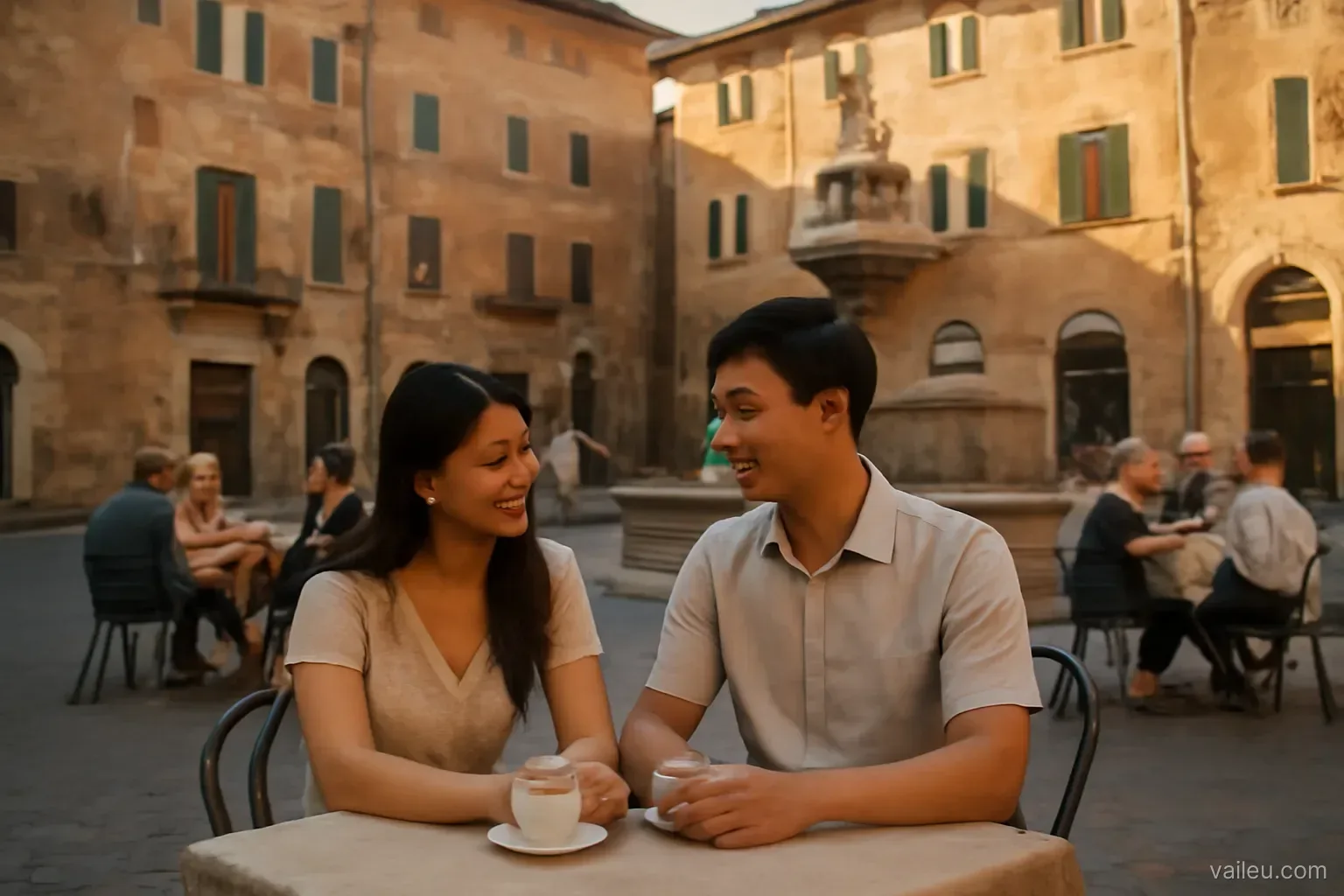
Almost every Italian town has a piazza, a central square with a church, town hall, cafés and a fountain. It is not just an architectural space but the stage of social life: older people chatting on benches, children running about, couples meeting and travellers resting their feet.
In the early evening many towns hold the passeggiata, a leisurely stroll along the main street. People dress a little more smartly, walk slowly, greet acquaintances and stop for an ice cream or a small drink. There is no grand purpose, only the feeling of belonging to a community.
- Visit the main square in the early evening to feel the local rhythm.
- Drink your coffee standing at the bar like Italians do; it is often cheaper than table service.
- Look out for parish festivals, which often take place right in the piazza.
- Smile and say buongiorno or buonasera to shopkeepers you see regularly.
Bella figura: looking after appearances as a courtesy
Italians speak of bella figura, making a good impression. It covers dressing neatly, behaving appropriately, presenting food beautifully and speaking with grace. It is not vanity but a way of showing respect for others and for oneself.
For travellers, applying this spirit is simple: dress modestly in churches, avoid walking barefoot or shirtless in town and keep your table tidy. Such small gestures earn a warmer welcome.
Talking with the hands
Italians are famous for expressive gestures. Many have specific meanings understood nationwide, such as bunching the fingertips together to ask what on earth you mean. Loud voices, fast speech and heated debates about football or local politics do not mean anyone is angry.
Newcomers sometimes think two people are arguing, only to see them laughing and hugging a few minutes later. It is simply the way Italians show enthusiasm and emotion in conversation, and after a while visitors often catch themselves gesturing too.
Slow living and savouring the moment
Italians have the expression dolce far niente, the sweetness of doing nothing. It is not a celebration of laziness but of the ability to enjoy simple moments: lingering over lunch, watching the sunset over the sea, chatting with friends without rushing.
In many small towns, shops close at midday so people can go home to eat and rest. Those used to a fast pace need time to adjust, but it is also a reminder that time for family and oneself matters as much as time at work.
Local festivals: where identity comes alive
Every Italian city has its own festivals, linked to a patron saint, to local history or to the harvest. Some towns hold horse races in the main square between rival neighbourhoods, others stage parades in Renaissance costume, and many celebrate a local product such as mushrooms, chestnuts or lemons. Residents prepare for these events all year round.
For visitors, arriving in a town during its festival is the most vivid way to understand local identity. You will see elderly people, teenagers and small children wearing the colours of their district, singing traditional songs, and campanilismo becomes visible in the clearest possible way.
- Check the festival calendar on the region’s official tourism website before travelling.
- Book accommodation early, as small towns fill up quickly on festival days.
- Respect religious rituals when a festival is linked to the church and stay quiet as processions pass.
Craft, design and the pride of making things well
Italian identity is also bound up with making things well. From leather workshops in Florence to violin makers in Cremona, glassblowers near Venice and ceramic painters in the south, many crafts have been passed down through families for generations. The phrase made in Italy carries a reputation built by small workshops as much as by large brands.
Visiting a workshop, where permitted, and asking politely about the process is often welcomed. Artisans tend to be proud to explain their work, and the conversation reveals how closely craft, place and family history are woven together in Italy.
What visitors can take home
- Treat a shared meal as a moment of connection, not just a way to eat.
- Keep pride in your home town while staying open to the world.
- See care for appearance and manners as respect for others.
- Make room for simple moments with the people you love.
- Value local distinctiveness within a unified nation.
Italy is not only an open-air museum of Renaissance art but also a society that knows how to live well in its own way. When you visit, take time to sit in a small piazza and watch life go by. It may be the deepest lesson about identity the journey offers.
Frequently asked questions
What is campanilismo?
It is pride in one’s home town, literally attachment to the bell tower of the local church. Many Italians introduce themselves as Neapolitan or Florentine before saying they are Italian.
Why is regional identity so strong in Italy?
The peninsula was divided into many states, duchies and city republics for centuries before unification in the nineteenth century. Each region kept its own dialect, cuisine and traditions.
What is the passeggiata?
It is the leisurely early-evening stroll along the main street or square to meet people, greet neighbours and enjoy the town. It is a characteristic social ritual in many Italian towns.
What should visitors keep in mind when talking to Italians?
Greet people politely, use the formal Lei with strangers and older people, dress modestly in churches and do not be surprised by lively hand gestures, which are part of how Italians express themselves.
What feels familiar to Vietnamese visitors in Italy?
Strong family ties, love of the home town and the joy of sharing a long meal together are things many Vietnamese find instantly familiar in Italy.