The first ten seconds of meeting someone in Europe are often the most awkward part for newcomers from Vietnam. Offer a hand or wait? Lean in for a kiss or not? Call the lecturer by title, by first name, or Mr plus surname? Vietnamese has its own elaborate system of address, learned from childhood. Europe has dozens of local habits, many of them absent from grammar books. This guide covers the basics: greeting gestures, formal and informal address, titles, greetings in public places, and how to introduce a Vietnamese name so Europeans get it right.
The handshake: the safe default almost everywhere
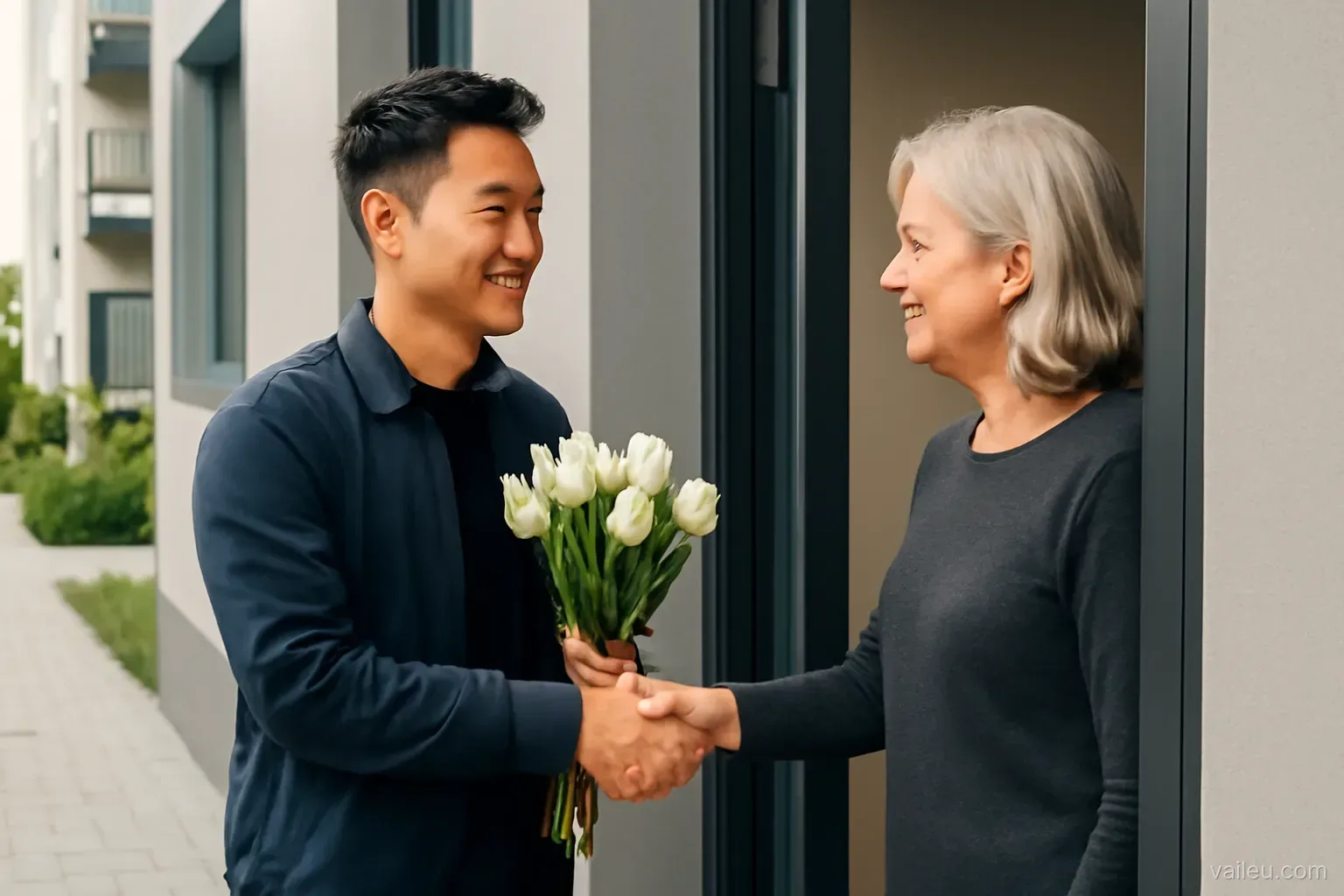
When in doubt, shake hands. It is the standard greeting at work, at university and at first meetings in most European countries. A few points where habits differ:
- Grip. Europeans, especially in the north and centre, shake firmly and briefly, one or two pumps. A limp grip can read as shyness or lack of interest.
- Eye contact. In Vietnam looking down when greeting an elder shows respect. In Europe looking someone in the eye while shaking hands is the respectful choice; avoiding eye contact can seem evasive.
- One hand. No need to support with the other hand as you might with elders at home.
- Everyone individually. In a small meeting in Germany or Austria people often shake hands with each person on arrival and departure rather than giving one general wave.
- Stand up. If someone comes to greet you while you are seated, standing to shake hands is polite.
Since the pandemic some people shake hands less, particularly with strangers. If the other person does not offer a hand, a nod and a spoken greeting are perfectly fine.
Cheek kisses: by country, region and circle
Greeting by touching cheeks and making a light kissing sound is common in France, Belgium, Italy, Spain, Portugal, the Netherlands, French-speaking Switzerland and much of south-eastern Europe. It is not a real kiss: cheeks touch or nearly touch, lips do not touch skin.
| Where | Typical habit |
|---|---|
| France | La bise, the number varies by region from one to four; two is most common |
| Spain, Italy, Portugal | Usually two between acquaintances, even when introduced through friends |
| Netherlands, Belgium | Often three between close acquaintances |
| Germany, Austria, Nordics, UK | Fewer cheek kisses; handshake or a light hug among friends |
These are tendencies, not rules. Habits vary between city and countryside, between generations, and between men and women. Cheek kisses rarely appear in a first business meeting.
The simplest approach: let the local person lead. If they lean in, follow and count with them. If you are uncomfortable, offer your hand first; Europeans will understand and shake it without offence.
Formal or informal: du, Sie, tu, vous
Many European languages have two ways to say “you”: formal and informal. German has Sie and du, French vous and tu, Italian Lei and tu, Spanish usted and tú. English lacks the distinction in pronouns but keeps it in naming: Mr or Ms with a surname versus a first name.
- With strangers, shop staff, officials, older people, professors and managers, use the formal form.
- Among students, young people and friends, the informal form comes almost immediately.
- The switch from formal to informal is usually offered by the older or more senior person. In Germany this was once a small ritual; it is more relaxed now, but it is still better to wait for the offer.
- Countries differ. Spaniards and Scandinavians use the informal form far more widely than Germans or the French. In Sweden the formal form largely disappeared from everyday speech decades ago.
Foreigners who get it wrong are usually forgiven. Still, addressing an official or a senior professor in Germany, Austria or France informally can chill the conversation. When unsure, stay formal; the other person will suggest something warmer if they wish.
First names, surnames and titles
In formal settings Europeans use a title plus surname: Herr Schmidt, Frau Weber, Madame Martin, Signora Rossi. First names are a step towards familiarity. In Britain and the Nordics the move to first names is quick, even at work; in Germany, Austria and France it is slower.
Academic titles carry weight in German-speaking countries. Holders of a doctorate are often addressed as Herr Doktor or Frau Doktor with their surname in formal contexts, professors as Herr Professor or Frau Professorin. Austria takes titles even more seriously, including professional ones. In the Netherlands or Scandinavia, students calling professors by first name is normal.
For students, the safe route is to use title and surname in the first email to a lecturer, then see how they sign their reply. If they sign with a first name, you can probably use it next time.
Vietnamese names: introducing yourself clearly
Vietnamese names put the family name first and the given name last, the reverse of European order, and a large share of Vietnamese people share a handful of surnames such as Nguyen, Tran and Le. The result: five students in one class all called “Mr Nguyen”, or a middle name mistaken for the given name on paperwork.
- Say what you want to be called right away. Someone named Nguyen Thu Ha might say: I’m Ha, my family name is Nguyen, please call me Ha.
- Keep documents consistent. European forms have two boxes: first name and surname. Fill them exactly as in your passport so records match.
- Offer a pronunciation. A rough guide helps, but do not be annoyed by imperfect attempts.
- Adopting an English name is a personal choice, not a requirement. Many Europeans would rather learn your real name.
Likewise, when you learn European names, note the spelling. Names like Siobhán, Joachim or Małgorzata sound very different from how they look; getting someone’s name right is a mark of respect people notice immediately.
Greeting in public: shops, lifts, waiting rooms
Many newcomers are surprised that Europeans greet strangers. In France, entering a bakery, pharmacy or small shop without saying “Bonjour” to the shopkeeper is considered rude, and “Merci, au revoir” is the natural way out. In Germany, Austria and Switzerland people greet the room when entering a doctor’s waiting room, when stepping into an occupied lift, and when passing others on a mountain trail.
- Grüß Gott in Bavaria and Austria, Grüezi in German-speaking Switzerland, Moin in northern Germany.
- Mahlzeit is a lunchtime greeting in many German and Austrian workplaces.
- In Italy buongiorno lasts until about early afternoon, then buonasera takes over, much earlier than an English speaker might expect.
The Nordics are the opposite: people rarely greet strangers in the street, and keeping your distance is a form of respect. Nobody greeting you on a bus in Helsinki does not mean they are cold.
Gestures that go with greetings
- Toasting. In Germany and much of central Europe, look each person in the eye when clinking glasses. Looking away is impolite, and some joke that it brings bad luck.
- Visiting a home. Bring a small gift such as flowers, chocolates or wine. In some central and eastern European countries flowers are given in odd numbers, as even numbers are for funerals; a ready-made bouquet from a florist is a safe choice.
- Shoes. In the Nordics, Poland, Czechia and many central European homes, people take shoes off at the door, much as in Vietnam. In France, Italy and Spain they usually do not. Just ask.
- Saying goodbye. Leaving a party without saying goodbye to the host and the people you talked to is impolite. In some countries farewells take a while; relax into it.
When you get it wrong
Europeans are generally forgiving of foreigners’ greeting mistakes. A misjudged kiss, a weak handshake, du instead of Sie: a smile and a short apology are enough. What bothers people more is indifference: not greeting the shopkeeper, not looking at the person speaking to you, not remembering a name after two introductions.
If you remember only one thing, make it this: greet first, look people in the eye, use the right name. The number of kisses you will pick up from the people around you.
Frequently asked questions
Do I have to kiss cheeks when meeting a French person for the first time?
In business or with an older person you have just met, a handshake is safe. Cheek kisses usually come when you are introduced through friends; let the local person take the lead.
When can I switch from Sie to du in German?
Usually the older or more senior person offers it. Among students, du is used from the start.
Is it rude when Europeans call me by my family name, Nguyen?
No, they are following the habit of using surnames in formal settings. If you prefer your given name, say so clearly when you introduce yourself.
Should I greet staff when entering a small shop?
Yes. In countries such as France, Belgium, Germany and Austria a greeting on entering and a thank-you on leaving is the minimum courtesy.
Are hugs common as greetings in Europe?
Among close friends, yes, especially in southern Europe and among young people. With new acquaintances, particularly in the Nordics, a handshake or a spoken greeting is enough.