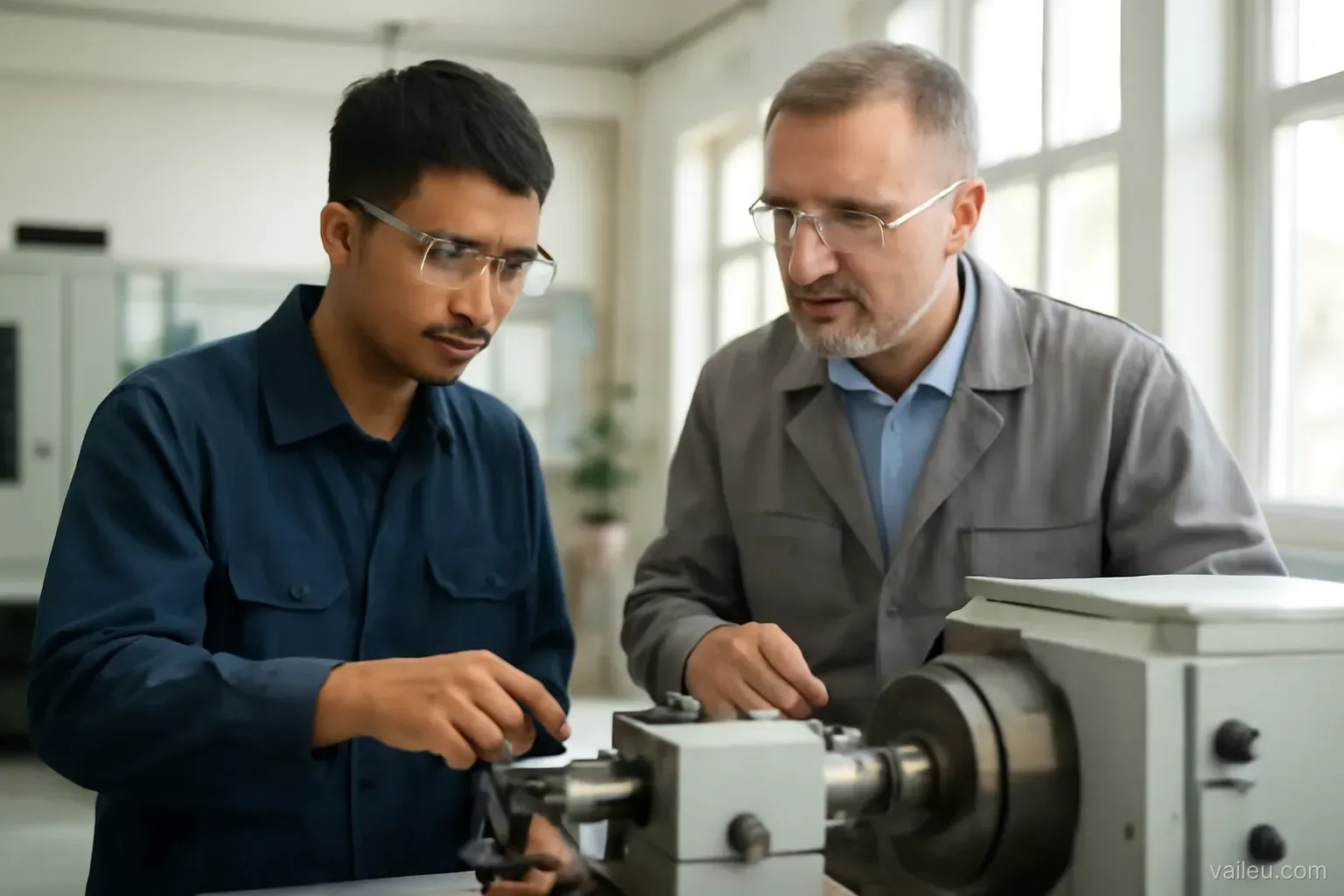
Dual vocational training is a model in which a learner signs a contract with a company, spends most of their time doing real work there, and attends a vocational school for theory. Trainees receive a monthly allowance and finish with an examination organised by professional bodies. The model is most widespread in Germany, Austria and Switzerland, where a large share of young people choose an apprenticeship instead of going straight to university.
In Vietnam it is often marketed as “vocational study in Germany”. To understand it properly, it helps to see that it is not a shortcut to Europe but a serious, respected training system that demands hard work and good language skills.
Why it is called “dual”
“Dual” refers to two places of learning running in parallel. At the company, trainees work under a certified trainer, learning real processes, real machines and real customers. At school, they study the theory of the trade plus general subjects such as language, applied maths and economics.
Both sides follow a training plan based on a national framework for each occupation, developed jointly by the state, employer associations and worker representatives. That is why an electrician trained in one city has comparable skills to one trained elsewhere, and why employers trust the certificate.
Why society values vocational training
In much of Asia, vocational training is often seen as second best to university. In Germany, Austria and Switzerland, attitudes are different. A skilled master craftsperson is respected, earns a stable income, can open their own business and train the next generation. Many business leaders started as apprentices.
The deeper reason lies in industries built on quality and precision. Machinery, medical devices, cars, watches and high-quality food all depend on people who understand their craft deeply. Dual training is how these societies renew that workforce from one generation to the next.
What a year of dual training looks like
- Three to four days a week at the company, or longer blocks, depending on the trade.
- One to two days at vocational school for theory and general subjects.
- A training record book listing tasks completed, signed off by the trainer.
- Intermediate and final examinations with theory and practical parts.
- Paid holidays under the contract, as for any employee.
Trainees do not just watch. From the first year they take part in real work with growing responsibility. That speeds up learning but also brings pressure, because mistakes in real work have real consequences.
Common occupations
Dual training exists for hundreds of occupations, from mechanics, electrical work, mechatronics, construction and automotive trades to nursing, elderly care, hospitality, retail, office work and IT. Sectors facing shortages, such as healthcare and some technical trades, often appear in programmes recruiting from abroad.
Yet “shortage occupation” does not mean easy. Nursing and elderly care require good health, patience and language skills strong enough to communicate safely with patients. People who choose a field only because it seems easier for a visa often struggle in the first year.
How Vietnamese applicants should prepare
- Language first. Most programmes run in German. Being able to follow lessons, read safety instructions and talk with colleagues is essential.
- Research the occupation. Read job descriptions, watch videos of a working day and talk to people in the trade. Choose something that fits your health and personality.
- Understand visa and recognition rules. Entry conditions for training are set by each country’s immigration authority and can change; read official sources.
- Be wary of agents who promise too much. Ask about costs, which company signs the training contract, and who is responsible if the contract is cancelled.
- Prepare for the first year. Weather, pace of life and direct communication can be a shock; family or community support helps.
After graduation
Graduates hold a qualification widely recognised by employers, and many stay on with the company that trained them. Some progress to master craftsperson or advanced technician levels; others move into universities of applied sciences. Each route has its own conditions, so check the specific rules of each country.
Money and daily life during training
The training allowance is designed to support a young trainee, not to replace a full salary. Rent, health insurance, transport and food must fit within it, which can be tight in expensive cities. Many trainees share flats, use regional transport passes and cook at home. Understanding a payslip, taxes and social insurance contributions is part of the learning, and employers and schools often provide guidance.
Daily life also brings cultural adjustments: punctuality is expected, safety rules are strictly enforced, and feedback is usually direct. Trainees who ask questions early and keep their training record tidy tend to settle in faster.
Common misconceptions
- “You get a job as soon as you arrive”: you need a training contract, and companies choose their trainees.
- “Language is not important”: weak language skills are the main reason trainees drop out.
- “An apprenticeship is just labour export”: it is structured education with exams, rights and duties.
- “Shortage occupations are easy”: they are often physically and emotionally demanding.
Keeping these points in mind helps families judge offers realistically. A trustworthy programme is transparent about the training company, the contract, the language requirement and what happens if things do not work out. Anyone who avoids those questions deserves caution.
Lessons for Vietnam
The most valuable lesson is not the two-site structure but the commitment of companies. Employers in these countries see training apprentices as a responsibility and an investment rather than a burden. Professional bodies run the exams that keep standards high, and society treats skilled workers with respect.
For a young Vietnamese person torn between university and vocational training, the experience of Germany, Austria and Switzerland suggests that a highly skilled trade is a dignified path in its own right, not a fallback for those who could not get into university. Vietnamese vocational schools and businesses could borrow parts of the idea — shared standards, real workplace learning and exams run with industry — even without copying the whole system.
Frequently asked questions
How long does dual training take?
Usually two to three and a half years depending on the trade, with most of the time spent at the company and the rest at vocational school.
Are trainees paid?
Yes. Trainees sign a training contract and receive a monthly training allowance, which varies by sector, country and year of training.
Can foreigners join dual training?
Yes, if they meet visa requirements, have a training contract and sufficient language skills. Conditions differ by country, so check official immigration websites.
What German level is needed?
Enough to follow theory classes and communicate safely at work. Exact requirements depend on visa rules and the employer.
Can graduates go on to university?
These countries offer routes from vocational qualifications to higher levels, but detailed conditions differ by country and field.